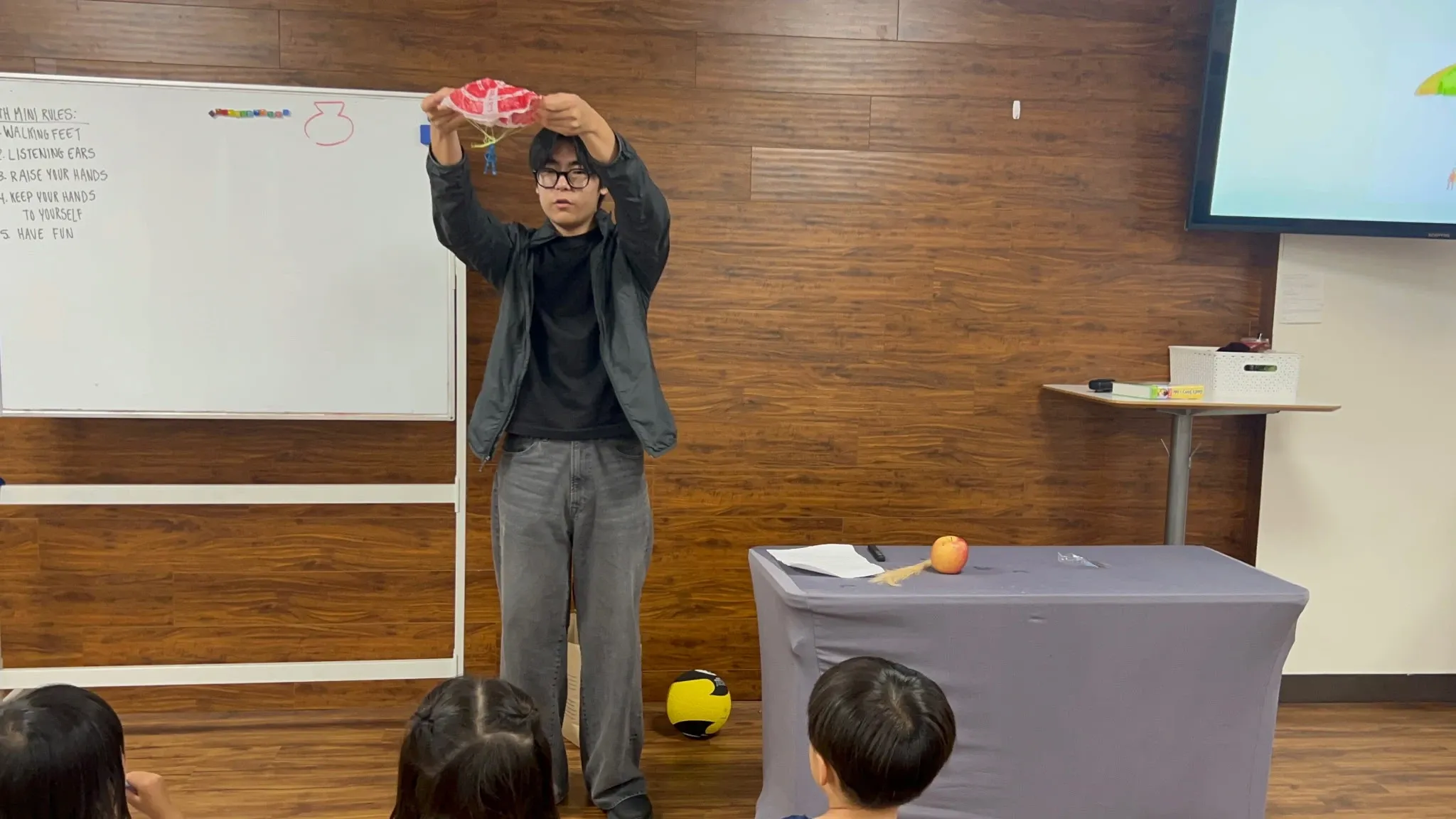
Feathers, paper, parachutes, and flying toy soldiers helped Jack Lee bring the invisible force of air resistance to life for a group of curious young scientists.
Jack began by asking the students to think about what happens when different objects fall. A feather drifts gently toward the ground, while a piece of paper may flutter, spin, or glide instead of dropping straight down. Although these objects are being pulled downward by gravity, the air around them pushes back as they move. This opposing force is known as air resistance.
He explained that air behaves much like a fluid. Just as water pushes against us when we swim, air pushes against falling or moving objects. The more surface area an object has, the more air it must move through and the greater the resistance can be. This helped the students understand why a flat sheet of paper falls differently when it is crumpled into a small ball.
Jack then connected this everyday science to one of the most important uses of air resistance: parachutes. A parachute opens into a large surface area, allowing it to catch more air and create drag. This drag slows a skydiver’s descent and makes it possible to land safely rather than falling quickly to the ground.
The young scientists were able to explore this idea for themselves during a hands-on activity. Each student received a toy soldier equipped with a small parachute and was encouraged to release it from a height. They watched as the parachutes opened and the soldiers floated downward, providing a clear demonstration of air resistance at work.
Some parachutes drifted smoothly, while others twisted, tilted, or landed in different directions. These variations gave the students opportunities to make observations, compare results, and think about how parachute size, shape, and the way it was released could affect the fall.
Through a simple and engaging experiment, Jack showed that science is happening all around us, even in something as ordinary as a piece of paper falling to the floor. By combining explanation with experimentation, he helped the young scientists see how the same force that slows a feather can also help protect people during a skydive.
It was another exciting STEM Inspire lesson filled with questions, discovery, and plenty of parachuting toy soldiers.
More from the day

